How Are Implant Prices Determined?
Implant prices vary based on many factors like brand, materials, and the clinic's expertise. Very cheap options can signal compromises. Always ask what's included. For long-term trust, choose quality over the lowest price. #İmplanttr
How Are Implant Prices Determined?
Is Going for the Cheapest Option the Right Move?
Almost everyone who wants to get an implant quickly realizes this:
You call one clinic, you call another clinic, you search online…
Implant prices vary greatly from one place to another.
-
"It's this much at one place, almost half that at another…"
-
"Where does such a big difference come from?"
-
"Is the cheap one bad, is the expensive one overpriced?"
In this article, we will explain, in a language everyone can understand, the key factors that affect implant prices independently of brand or clinic, and what risks are involved in "choosing only the cheapest option."
Key Elements That Determine Implant Prices
Implant treatment is not a single-item procedure.
The price is formed by the combination of many factors such as the materials used, additional procedures performed, the doctor's experience, and the clinic's infrastructure.
Generally, the main elements affecting implant prices are:
-
The implant brand and system used
-
The superstructure material (porcelain or zirconia?)
-
Necessary additional surgeries (bone graft, sinus lift, extraction, etc.)
-
The clinic's technological infrastructure and sterilization conditions
-
The doctor's experience and the quality of the team
-
The city, country, and general overhead costs of the clinic
Now, let's break these down one by one in simple terms.
1. Implant Brand and Manufacturing Quality
While every implant may look like a "screw," there can be significant differences behind the scenes.
-
Implant brands that have been used for many years, with scientific studies and long-term follow-ups,
are generally higher in cost. -
Systems with high manufacturing quality, good connection precision, and advanced surface technology;
work more predictably for both the surgeon and the technician.
There are also more economical implants, and it's not correct to say they are all bad.
However:
-
With products that are unheard of, have an unclear clinical history, or lack clear certifications, long-term risks may increase.
In summary, a significant part of the implant price depends on the quality and reliability of the material.
2. The Superstructure: Porcelain, Zirconia, Which System?
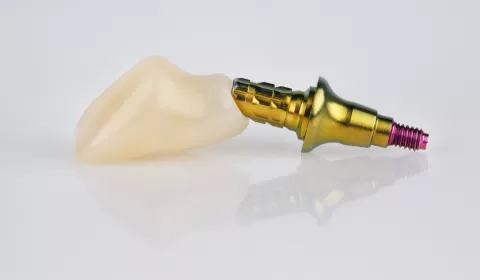
It's not just the implant "screw" that affects the price, but also the crown (restoration) placed on top of it.
-
In the back area, metal-supported porcelain is sometimes preferred,
-
In the front area, zirconia or full ceramic crowns may be used for a more aesthetic result.
Zirconia and full ceramic materials are:
-
More aesthetic,
-
Have light translucency close to natural teeth,
-
Long-lasting,
but are generally more costly than classic metal-supported porcelain.
Additionally, the abutment piece that connects the implant to the crown:
-
Whether it's standard or custom-made,
-
Whether it's metal or zirconia,
also affects the total price.
So when asking for a price, the answer to the question "What kind of tooth will be placed on this implant?" is also important.
3. Additional Procedures: Is It Just the Implant, or Are There Bone Grafts, Sinus Lifts Too?
In some patients:
-
The bone at the extraction site has resorbed,
-
The sinus cavity has descended too low,
-
The jawbone is very thin or narrow.
In these cases, before or along with the implant placement:
-
Bone graft application,
-
Sinus lift surgery,
-
Other surgical additional procedures may be necessary.
Naturally, in this case, more materials, time, and effort are spent than just "placing an implant."
Therefore:
The answer to the question "Why do you think the implant turned out to be expensive?"
is often because "It's not just the screw, but also the surrounding repair procedures are included."
When getting a quote, be sure to ask:
-
Is bone graft included in the price?
-
If needed, is the sinus lift fee separate?
-
Are tooth extraction and temporary teeth included in the price?
4. The Clinic's Infrastructure, Sterilization, and Technology
Part of the price is also the environment where the treatment is performed.
-
Clinics that strictly adhere to sterilization rules,
-
Generously use single-use materials,
-
Contain modern technologies like digital X-rays, tomography, intraoral scanners
naturally have higher overhead costs.
Such investments return to the patient as:
-
Safer surgery,
-
More accurate planning,
-
More predictable results.
Sometimes, it's beneficial to ask where "cuts have been made" in places offering very, very low prices, from the materials used to sterilization conditions.
5. The Doctor's Experience and the Team's Quality
Implant treatment requires a certain level of experience in terms of surgery, prosthetics, and planning.
-
A doctor who has seen hundreds–thousands of cases,
-
An experienced surgical–prosthetic team,
-
Good technician support,
affects the success and longevity of the treatment.
Since this experience contains years of effort and education, it naturally reflects on the prices.
It's not correct to say everything expensive is good, and everything cheap is bad;
but making a choice "just because it's cheap" is also not correct.
6. City, Country, and General Overhead Costs
-
In big cities, rents, personnel expenses, taxes are higher; this can be reflected in treatment prices.
-
In some countries, due to reasons like exchange rate differences, tax burden, health regulations, implant treatments may be in different price ranges.
That's why sentences like "Implants cost this much in that country" often only give a rough idea;
what's really important is what is included in that price.
What Could Very Cheap Implant Prices Mean?
Sometimes we see advertisements where:
-
There is a promise of implants at prices far, far below the general market.
Not every low-priced offer is necessarily bad;
it could be a clinic's campaign, stock situation, etc.
But if there is a huge price gap, these questions come to mind:
-
Which brand is the implant system used, how long has it been on the market?
-
Does it have certification, warranty, spare part access?
-
Could they be cutting corners on sterilization, single-use materials?
-
Are planning and control times shortened, providing a "fast but superficial" service?
Most importantly:
Whether a treatment is cheap or expensive,
becomes clear when you have a problem.
Correcting a poorly placed implant can sometimes be more costly and difficult than getting the treatment done correctly from the start.
Make Your Decision Based on Value, Not Just Price
An implant is not just about "replacing a tooth," it

M. İhsan GÜRSOY / Diş Hekimi
Author