Long-term Denture Use Vs. Implants: What Happens To Your Bone?
For many fully or partially edentulous patients, conventional dentures feel like the natural first step. They restore appearance and function fairly quickly and at a lower initial cost. But over the years, long-term denture use can quietly change the shape of the jaws—and not in a good way. Dental implants, on the other hand, interact with bone in a much more physiologic way.
Long-Term Denture Use vs. Implants: What Happens to Your Bone?
For many fully or partially edentulous patients, conventional dentures feel like the natural first step. They restore appearance and function fairly quickly and at a lower initial cost. But over the years, long-term denture use can quietly change the shape of the jaws—and not in a good way. Dental implants, on the other hand, interact with bone in a much more physiologic way.
This article explains what happens to the jaw over time with traditional prostheses and how implants can help support the bone.
What Long-Term Prosthesis Use Does to the Jaw
When teeth are lost, the alveolar ridge—the part of the jaw that used to hold the roots—no longer receives normal chewing forces. Without that stimulation, the body begins to “recycle” the bone in a process called residual ridge resorption (RRR).
Wearing a complete denture does not stop this resorption. In fact, research shows:
-
The alveolar ridge can resorb, on average, around 0.5 mm per year vertically in some complete denture wearers, with wide individual variation.
-
Over decades, studies have reported 30–40% ridge height loss in certain mandibular regions in long-term denture wearers.
Clinically, this can lead to:
-
Loose, unstable dentures as the ridge flattens
-
Need for repeated relining or remake of the prosthesis
-
Reduced lower facial height, giving an aged, “collapsed” profile
-
Burning or pain in the denture-bearing mucosa due to concentrated pressure on thin bone and soft tissue
In short: the longer a patient relies on conventional dentures alone, the more the foundation under those dentures tends to shrink.
How Dental Implants Benefit the Bone
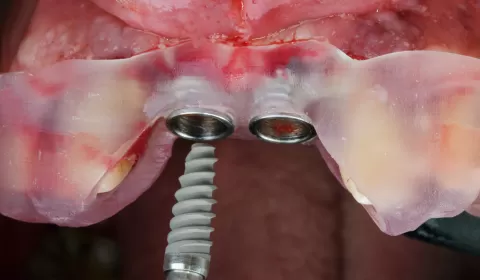
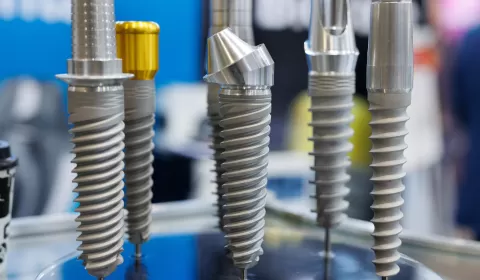
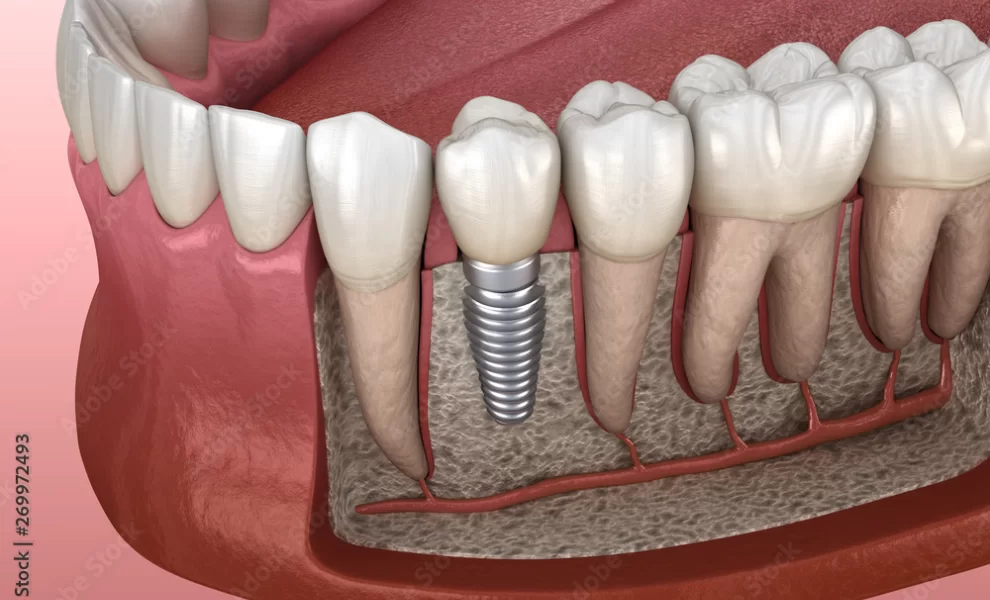
Dental implants are titanium fixtures placed in the jaw where roots once were. After placement, bone grows and attaches directly to the implant surface in a process called osseointegration. When the implant is then loaded with a crown or prosthesis, it can transmit chewing forces into the bone.
Current evidence suggests:
-
Mechanical loading through implants stimulates bone remodeling, with both resorption and bone formation occurring around the fixture, helping maintain density and structure in many cases.
-
Compared with conventional dentures alone, mandibular implant-supported overdentures are associated with significantly less ridge resorption—one clinical study reported around 60% reduction in mandibular ridge resorption in implant-supported cases.
It’s important to be accurate: implants do not magically freeze all bone loss forever. Physiologic remodeling still occurs, and some studies argue implants cannot completely prevent the natural post-extraction changes in alveolar bone height.
However, by reintroducing functional load into the jaw, implants tend to help preserve more bone volume and density over time compared with dentures that simply rest on the mucosa.
Functional and Esthetic Payoffs for Patients
The biological benefits of implants translate into very practical advantages:
-
More stable prostheses: An implant-supported overdenture or fixed bridge is far less dependent on ridge height and suction, so it stays put during speaking and chewing.
-
Improved chewing efficiency: Stronger bite forces and better control mean a more varied diet and improved nutrition.
-
Slower facial collapse: By helping the jaw maintain more bone, implants support the lower third of the face, contributing to a younger, more natural profile.
-
Fewer adjustments: Less rapid ridge resorption means fewer relines and remakes over the years, which can offset the higher initial cost.
The Takeaway for Long-Term Oral Health
Conventional dentures can restore function and appearance, but they sit on the bone rather than working with it. Over time, this often leads to ongoing bone loss, less stability, and progressive changes in facial appearance.
Dental implants, by contrast, act more like natural roots. They integrate with the jaw and transmit forces that encourage the bone to stay active and structurally useful. While they don’t completely stop remodeling, they typically help patients keep more bone, more stability, and more comfort over the long term.
For any patient thinking about the next 10–20 years—not just the next 10–20 months—implant-supported solutions are usually the more bone-friendly path.
The Hidden Cost of Tooth Loss: Why Implants Are the Only True "Anti-Aging" Solution for Your Jaw
When a tooth is lost, the immediate concern is usually the gap in the smile. However, a much more serious process begins beneath the gum line the moment a tooth is extracted: bone resorption. While traditional dentures and bridges restore the appearance of teeth, they do not stop the biological process of bone loss. In fact, traditional removable prostheses often accelerate it.
Here is a look at the long-term results of wearing traditional dentures versus the bone-preserving power of dental implants.
The "Use It or Lose It" Reality of Jawbone
Bone is a living tissue that requires stimulation to maintain its density and volume—a principle known as Wolff’s Law. Natural tooth roots transmit compressive and tensile forces to the surrounding bone, stimulating it to remodel and remain dense.
When a tooth is lost, this stimulation ceases. The lack of strain on the bone causes a decrease in trabeculae (the internal mesh-like structure of bone) and density. The consequences are immediate and aggressive:
Rapid Initial Loss: There is a 25% decrease in bone width during the first year after tooth loss.
Vertical Loss: An overall 4-mm decrease in bone height occurs during the first year following extractions for an immediate denture.
Continuous Atrophy: Bone loss continues throughout life, eventually causing the jawbone to become paper-thin.
How Traditional Dentures Accelerate Aging
Many patients assume dentures are a complete replacement for teeth. Biologically, they are not. A removable denture sits on top of the gum tissue and does not stimulate the bone inside the jaw. Instead, the pressure from mastication (chewing) is transferred only to the bone surface, often reducing blood supply and causing total bone volume loss to occur.
Long-term denture wearers often experience severe anatomical changes known as "facial collapse":
Prognathic Appearance: As the vertical height of the jaw shrinks, the chin rotates forward, creating a "witch's chin" appearance.
Thinning Lips: The loss of muscle tone and bone support causes the vermillion border (the red part of the lip) to thin and invert, making the patient appear unhappy or angry when at rest.
Deepening Wrinkles: Vertical lines in the face deepen, and the angle between the nose and lip becomes more acute, significantly aging the patient's profile.
Furthermore, function is severely compromised. A patient with natural teeth can exert 150 to 250 psi of force. A long-term denture wearer may be reduced to less than 50 psi—and after 15 years, as little as 5.6 psi. This reduced efficiency forces many patients to avoid healthy, high-fiber foods, potentially impacting their overall lifespan and nutrition.
The Implant Solution: Bio-Esthetics and Function
Dental implants are unique because they are the only restoration that replaces the root of the tooth, not just the crown. This restores the natural stimulation required to maintain alveolar bone.
1. Halting Bone Loss
An endosteal implant can maintain bone width and height as long as the implant remains healthy. The stress transferred from the implant to the bone reverses the decrease in trabeculation that occurs after extraction, actually increasing bone density around the implant.
2. Restoring Youthful Structure
Because implants prevent the collapse of vertical bone height, they maintain the natural proportions of the face. The muscles of facial expression retain their tone and attachment, preventing the "jowls" and sagging skin associated with denture wear.
3. Superior Success Rates
From a clinical standpoint, implants are highly predictable. Single-tooth implants have success rates above 97% for 10 years. Unlike bridges, which require grinding down adjacent healthy teeth (leading to a 30% failure rate of those abutment teeth within 14 years), implants protect adjacent teeth from decay and endodontic failure.
Conclusion
While traditional dentures can act as "oral wigs" to hide missing teeth, they cannot stop the biological consequences of bone loss. Dental implants offer a solution that mimics nature, maintaining the jawbone, preserving facial esthetics, and restoring bite force to near-natural levels.

M. İhsan GÜRSOY / Diş Hekimi
Yazar